
Pest Control for Villas in Al Ain — What a Full Treatment Covers
A full pest control treatment for villas in Al Ain covers interior inspection of every room, targeted treatment for cockroaches, termites, bed bugs, ants, rodents, mosquitoes, and flies, perimeter spray along all exterior walls, drainage system treatment, garden boundary protection, and a guaranteed follow-up visit. Municipality-approved companies apply this complete scope in a single structured visit that addresses both active infestations and exclusion at the same time. If you have ever wondered exactly what happens during a professional villa treatment, this guide covers every zone, every pest, and every step.
Why Villa Pest Control Is More Complex Than Apartment Treatment
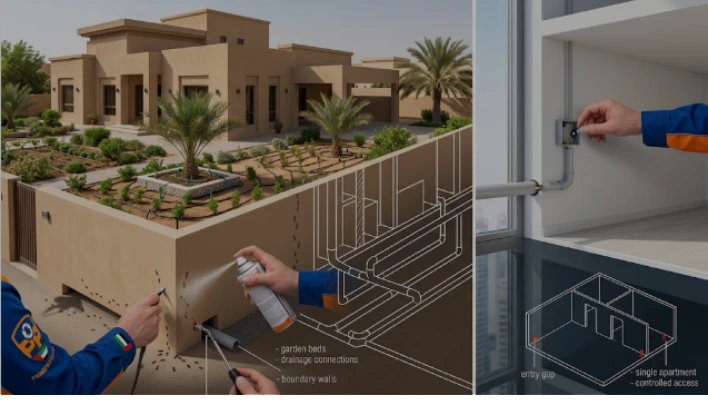
Treating a villa is a completely different job from treating an apartment. The scale is larger. The entry points are countless. The outdoor areas, service rooms, drainage connections, and garden boundaries all create pest access routes that do not exist in high-rise apartments.
Al Ain villas are particularly complex because of the city’s unique environment. The warm desert climate, widespread irrigation systems, shared drainage infrastructure, and lush greenery all create ideal conditions for cockroaches, termites, ants, and mosquitoes. A treatment that covers only the kitchen and bathroom misses most of the problem.
What Makes Al Ain Villas High-Risk
Villas in areas like Al Hili, Al Jimi, Al Muwaiji, and Al Towayya feature large garden areas with irrigation pipes, outdoor kitchens, shaded service rooms, and vast plumbing networks. Each of these zones is a potential shelter point for a different pest species. A proper full-villa treatment maps out every one of these zones before a single product is applied.
Phase 1: The Professional Inspection
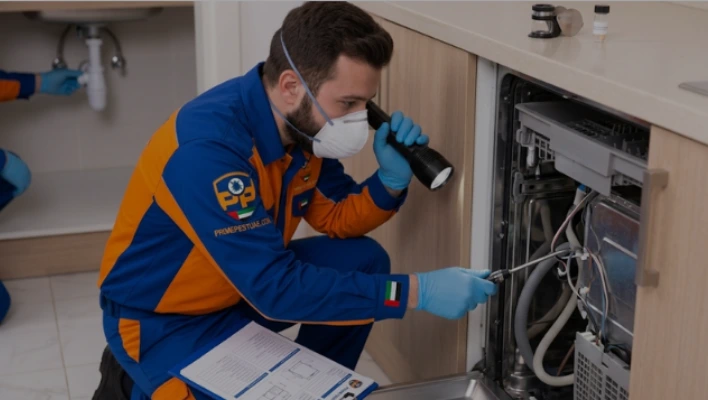
Every full villa treatment begins with a thorough inspection. This is not a five-minute walkthrough. A Prime Pests trained technician spends 30 to 60 minutes inspecting every accessible area of your property.
Interior Inspection Zones
Prime Pests technician checks inside all kitchen cabinets, behind and under every major appliance, plumbing under sinks, bathroom drainage areas, wall-floor junctions, electrical socket panels, fitted wardrobes, under all beds, false ceiling access points, utility rooms, and laundry areas.
This inspection identifies which pest species are active, where their shelter points are, how severe the infestation is, and which entry points are allowing new pests to enter. Without this data, no treatment can be accurately targeted.
Exterior Inspection Zones
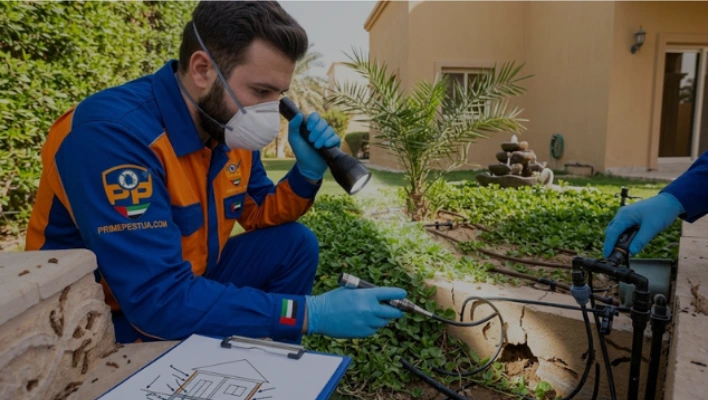
Outside the villa, the Prime Pests technician inspects perimeter walls, garden boundaries, external drainage points, outdoor storage areas, garage spaces, garden irrigation connections, outdoor kitchen areas, pergolas, and any decorative water features. Pest entry routes from the garden into the main structure are mapped during this phase. This is particularly important for termite control in Al Ain, where subterranean colonies build through garden soil before reaching the villa foundation.

Phase 2: Interior Treatment Zone by Zone
Kitchen Treatment
The kitchen receives the most intensive treatment in any villa. This is where cockroach infestations establish first and where the highest risk of food contamination exists.
Prime Pests technician applies professional gel bait inside all cabinets, behind the refrigerator and oven, along drainage connection points, near electrical socket areas, and inside a narrow crack along the wall-floor junction. Gel bait works through a cascade effect. Cockroaches that consume the bait carry the active ingredient back to the hidden colony. Other colony members ingest it through contact, reaching nesting sites deep inside wall gaps that a spray could never physically reach.
Residual microencapsulated spray covers floor-wall junctions and under-sink areas. This combined approach targets cockroach control in Al Ain, ants, and silverfish simultaneously in the highest-risk zone of your villa.
Bathroom and Plumbing Areas
Bathrooms are the primary entry route for American cockroaches (Periplaneta americana), which travel through shared drainage infrastructure and floor drain systems. The treatment here focuses on drainage openings, pipe penetrations, floor-wall junctions, and under-vanity cabinet areas.
Pipe penetration gaps are identified and flagged for silicone sealing after treatment. Mesh drain covers are recommended over all floor drains. This sealing step is critical for villas in Al Qattara and Al Jimi, where shared drainage systems run beneath multiple connected properties.
Bedroom and Living Area Treatment
Every bedroom receives a full bed bug inspection and treatment. The technician examines all mattress seams, bed frames, headboards, skirting boards, electrical socket areas, wardrobe interiors, and wall-floor junctions. Any signs of bed bug activity, including ootheca, droppings, shed exoskeletons, or live insects, are documented before treatment begins.
Living areas receive treatment along sofa undersides, wooden furniture joints, carpet edges, and skirting boards. These zones concentrate ant activity, flea harborage, and occasional cockroach foraging that migrates from the kitchen.
Utility Rooms, Laundry Areas, and Storage
These rooms are the most overlooked pest shelter zones in any villa. Undisturbed storage areas, dark corners, and consistent moisture from washing machines create ideal conditions for cockroaches, silverfish, and rodents.
A full treatment includes every utility and storage room as a standard zone. The Prime Pests technician applies gel bait along all wall-floor junctions, inside any built-in shelving, and near drainage points in laundry areas.
False Ceiling and Roof Void Areas
Where access points exist, the Prime Pests technician inspects and treats the false ceiling gaps. These spaces are primary shelter locations for German cockroaches (Blattella germanica) and Brown-banded cockroaches (Supella longipalpa), which prefer dry, elevated hiding spots far from standard treatment zones. Dust formulation insecticide is applied inside accessible ceiling gaps to reach these areas effectively.
Phase 3: Exterior and Garden Treatment
Perimeter Wall and Foundation Spray
Residual microencapsulated insecticide spray covers the full exterior wall base, boundary walls, external drainage points, and garden soil edges along the villa foundation. This chemical barrier targets ants, cockroaches, and rodents attempting to enter from outside. The microencapsulation bonds the active ingredient to surfaces, keeping it effective for four to six weeks after application.
Villas in Al Ameriya, Al Bateen, and Zakher with large garden boundaries benefit most from a thorough perimeter application, as open garden areas allow multiple pest species to approach the structure from several directions simultaneously.
Garden and Irrigation Area Treatment
Garden spaces receive targeted mosquito treatment covering standing water sources, irrigation outlets, shaded plant beds, and any water features. Mosquito larvae breed in as little as one centimetre of standing water. Eliminating these breeding sources is essential for mosquito control in Al Ain, particularly during the warmer months between May and October.
Ant colonies in garden soil receive direct granule bait treatment along visible foraging trails and near colony entry points. This stops garden ants from migrating inside the villa through foundation gaps.
Garage and Outdoor Storage Treatment
Garage areas are common entry and shelter zones for rodents and Oriental cockroaches (Blatta orientalis). Prime Pests technician applies residual spray along garage floor-wall junctions, around external door frames, and near any drainage points inside the garage. Rodent bait stations are placed in enclosed garage corners where rodent activity indicators such as droppings or bite marks have been identified.
Termite Inspection at Foundation Level
Every full villa treatment includes a visual termite inspection along the exterior foundation. The technician checks for mud tubes, soil disturbance near the foundation, and any wood-to-soil contact points in garden areas. If active termite signs are found, a separate termite treatment plan is recommended, which may include soil injection, bait station installation, or wood treatment depending on the species and extent of the infestation.
Phase 4: Insect Growth Regulator (IGR) Application
IGR treatment is one of the most important components of a thorough villa pest control plan, and one that many lower-cost providers skip entirely. IGRs are chemical compounds that disrupt the hormonal development cycle of insects. When cockroach or bed bug nymphs hatch from surviving egg casings (ootheca) after treatment, exposure to IGR prevents them from maturing into reproductive adults.
This single step breaks the breeding cycle and prevents the reinfestation that homeowners experience when surface-only treatments are applied without IGR. Without it, new generations emerge from surviving eggs within two to four weeks. With it, the colony cannot rebuild itself, regardless of how many eggs were present at the time of initial treatment.
Phase 5: Entry Point Sealing Recommendations
All the Pests a Full Villa Treatment Covers
A properly scoped full villa treatment in Al Ain targets every common pest species found in residential properties across the city.
Cockroach control covers all four species common in Al Ain villas. Termite inspection and treatment address both subterranean and drywood species. Bed bug control covers all bedrooms and living areas. Ant control covers both indoor and outdoor garden colonies. Rodent control covers rats and mice with bait station placement and entry point identification. Mosquito control covers all garden and outdoor breeding sources. Flies control covers the kitchen and waste area hotspots.
Depending on the villa’s specific location and surrounding environment, treatment for scorpions, spiders, silverfish, and lizard deterrence may also be included.
The Follow-Up Visit
A full villa treatment from a reputable municipality-approved pest control company in Al Ain always includes a follow-up visit between day 10 and day 21. This visit is not optional. It is the step that turns a temporary reduction into permanent elimination.
The technician re-inspects all previously treated areas, re-applies gel bait in zones showing continued consumption, and targets any newly hatched nymphs that emerged after the initial treatment. This two-visit structure is what separates a professional full treatment from a surface-only spray visit.
Areas in Al Ain We Cover for Full Villa Treatment
Prime Pest UAE provides full villa pest control treatment across all major areas of Al Ain. Our teams regularly serve villas in Al Hili, Al Muwaiji, Al Towayya, Al Jimi, Al Qattara, Al Ameriya, Zakher, Al Bateen, Al Dhaher, Al Masoudi, Al Jahili, Al Mutawaa, Al Yahar, Al Foah, Al Waqan, Al Khabisi, Al Ain Central District, Al Maqam, Nahil, and Mazyad.
No matter which part of Al Ain your villa is located in, our municipality-approved technicians reach you with the same full treatment scope and guaranteed follow-up visit.
Annual Maintenance Contract for Al Ain Villas
Many Al Ain villa owners find that an annual maintenance contract (AMC) delivers the best long-term value. An AMC schedules four quarterly visits per year, each covering the full treatment scope described in this guide. Plus, evaluating the overall pest control cost in Al Ain shows that the per-visit cost under a contract runs 20 to 30 percent lower than individual bookings.
Quarterly professional inspections also catch early signs of termite activity, rodent entry, or new pest introduction before they develop into costly problems. This preventive approach is significantly cheaper than managing a severe infestation that has been left untreated for several months.

Conclusion: Why Professional Treatment is Key
Your Al Ain villa deserves a treatment that covers every zone, every pest, and every lifecycle stage. Contact Prime Pest UAE today for a free inspection and a complete villa pest control plan built specifically for your property, your location, and the pests active in your area.
Frequently Asked Questions
How long does a full pest control treatment take for an Al Ain villa?
A full treatment for a standard three to four-bedroom villa takes four to six hours for the initial visit, including inspection, all interior zones, exterior perimeter, and garden treatment.
Do I need to vacate my villa during the pest control treatment?
For standard spray and gel treatments, you need to vacate treated rooms for two to four hours. If fumigation is included for a specific pest, such as termites, in a sealed space, full evacuation for a longer period applies. Prime Pest technician confirms the requirement based on the specific treatment plan before starting.
Does full villa pest control in Al Ain include a termite inspection?
Yes. A thorough full villa treatment always includes a visual termite inspection at the foundation and garden level. If active termite signs are found, a dedicated termite treatment plan is recommended separately.
How often should an Al Ain villa receive full pest control treatment?
Quarterly treatment under an annual maintenance contract is the most effective schedule. At a minimum, a complete treatment twice per year is recommended for all Al Ain villas.
Is the treatment safe for children and pets in Al Ain villas?
Yes. Municipality-approved companies, like Prime Pest, use certified, odourless formulations that are tested for residential indoor use. Residents with children or pets are asked to vacate treated areas during application and for two to four hours while surfaces dry.
Does a full villa treatment include the follow-up visit in the price?
Yes, from a reputable municipality-approved company. Like Prime Pest, always confirm the follow-up is included before booking. Some lower-cost providers exclude it from the quoted price and charge separately.